IFSA
  • HOME
  • ABOUT
  • OUR MEMBERS
    • Careers in Hospitality
    • Bathroom & Spa
    • Catering Equipment
    • Contract Caterers
    • Food & Drink
    • Industry Services
    • Interiors
    • Premises and Facilities Management
    • Sustainability
    • Tabletop
    • Technology
    • Training & Skills
  • BECOME A MEMBER
  • RESOURCES
  • LATEST NEWS
  • EVENTS
  • CONTACT
  • TABLE TO TECH 2026

EU issues a European "roadmap" to lifting coronavirus containment measures

17/4/2020

 
Picture
EU Commission President Ursula von der Leyen, has announced a European 'roadmap' to a co-ordinated lifting of COVID-19 containment measures amongst EU member countries.
"While there is no one-size-fits-all approach to a gradual, science-based and effective lifting of containment measures, a highly coordinated way forward is a matter of common European interest."

​Responding to the call of the European Council of 26 March, the Commission, in cooperation with the President of the European Council, has put forward a European roadmap towards lifting coronavirus containment measures. It takes into account the expertise of the European Centre for Disease Prevention and Control the Commission’s Advisory Panel on the coronavirus, experience of Member States and guidance from the World Health Organization. Evidently, any such reflection is based on the scientific knowledge available today, and should be revised as further evidence appears.
The fast evolving nature of the COVID-19 pandemic and the significant unknowns coming with a new virus and the disease it causes have led to unprecedented challenges for health care systems as well as to dramatic socio-economic impacts in Europe and the whole world. The crisis has already claimed thousands of lives and continues to put health care systems under enormous strain. Extraordinary and unprecedented measures – both economic and social – have been taken.
​
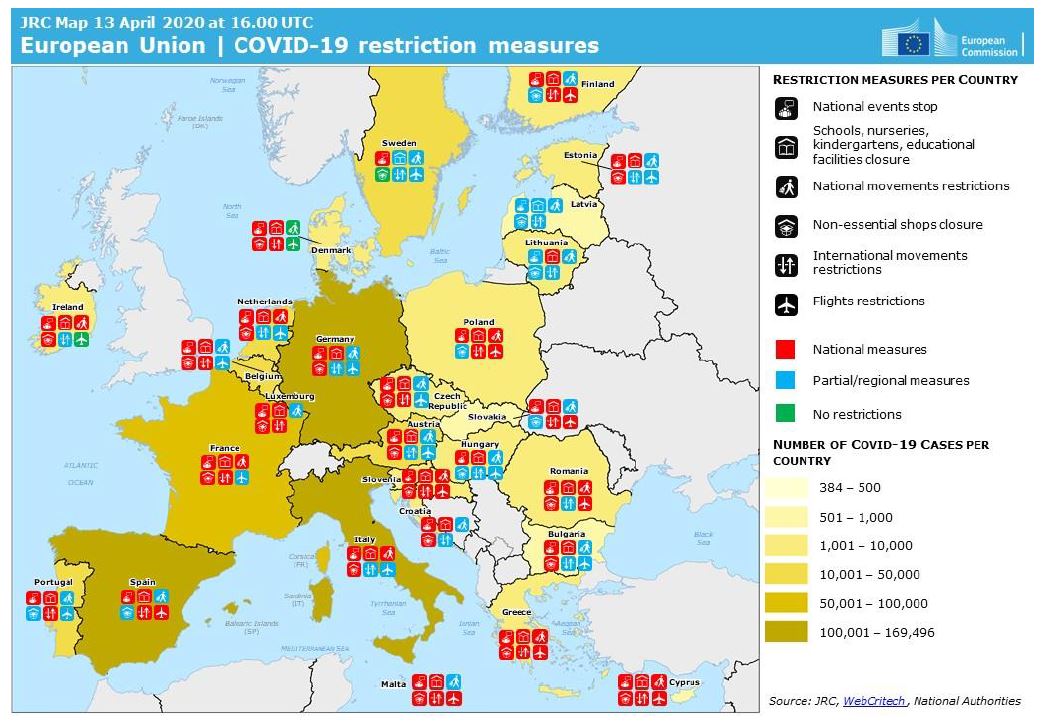
All Member States have prohibited public gatherings, closed (totally or partially) schools and introduced border/travel restrictions. More than half of the EU’s Member States have proclaimed a state of emergency.
Picture
NEXT STEPS:

​​The following recommendations should guide Member States’ reflections on gradually lifting containment measures:
  • Action will be gradual. Measures will be lifted step by step and sufficient time should pass between the steps (e.g. one month), as their effect can only be measured over time.
  • General measures should progressively become targeted. This would allow gradually going back to normality, while continuing to protect the EU population from the virus. For example:

  1. The most vulnerable groups should be protected for a longer time.
  2. Diagnosed people should remain quarantined and treated adequately to decrease transmission risks.
  3. Safe, targeted alternatives should replace existing general prohibitive measures.
  4. General states of emergencies should gradually be replaced by more targeted interventions by governments. This would ensure the democratic accountability of the measures taken and a wide acceptance by the populations.

  • The lifting of measures should start with those with a local impact and be gradually extended to measures with a broader geographic coverage, taking into account national specificities. This would allow for effective and tailored actions and the potentially swift redeployment of measures in case new infections occur.
  • A phased approach to opening internal and external borders to allow for the flow of essential workers and goods.

  1. Internal border controls should be lifted in a coordinated manner. Travel restrictions should first be eased between identified low-risk areas. Neighbouring Member States should stay in close contact to facilitate this.
  2. In a second phase, external borders would reopen access for non-EU residents, taking into account the spread of the coronavirus outside the EU. Restrictions to non-essential travel to the EU must be continuously reviewed.

  • Economic activity should be phased in to ensure that authorities and businesses can adequately adjust to increasing activities in a safe way. The whole population should not return to the workplace at the same time and social distancing should continue to apply. Teleworking should be encouraged. At the work place, occupational health and safety rules should be observed.
  • Gatherings of people should progressively be permitted. When reflecting on the most appropriate sequencing, Member States should focus on the specificities of different categories of activity, such as:

  1. Schools and universities.
  2. Commercial activity (retail) with possible gradation.
  3. Social activities (restaurants, cafés, sport centres) with possible gradation.
  4. Mass gatherings.
​​
  • Efforts to prevent the spread of the virus should be sustained, with awareness campaigns to encourage the population to keep up the strong hygiene practices and social distancing.
  • Measures should be continuously monitored and a certain readiness should be developed, as there is a risk of a strong resurgence and a return to strict containment measures. This is particularly important for health care systems.
Communication: Joint European Roadmap Towards Lifting COVID-19 Containment Measures
Factsheet: A European roadmap to lifting coronavirus containment measures

Comments are closed.

    Archives

    March 2026
    November 2025
    October 2025
    September 2025
    August 2025
    July 2025
    June 2025
    May 2025
    April 2025
    March 2025
    February 2025
    January 2025
    November 2024
    October 2024
    September 2024
    August 2024
    July 2024
    June 2024
    May 2024
    April 2024
    March 2024
    February 2024
    January 2024
    December 2023
    November 2023
    October 2023
    September 2023
    August 2023
    July 2023
    June 2023
    May 2023
    April 2023
    March 2023
    February 2023
    January 2023
    December 2022
    November 2022
    October 2022
    September 2022
    August 2022
    July 2022
    June 2022
    May 2022
    April 2022
    March 2022
    February 2022
    January 2022
    December 2021
    November 2021
    October 2021
    September 2021
    August 2021
    July 2021
    June 2021
    May 2021
    April 2021
    March 2021
    February 2021
    January 2021
    December 2020
    November 2020
    October 2020
    September 2020
    August 2020
    July 2020
    June 2020
    May 2020
    April 2020
    March 2020
    February 2020
    January 2020
    December 2019
    November 2019
    October 2019
    September 2019
    August 2019
    July 2019
    June 2019
    May 2019
    April 2019
    March 2019
    February 2019
    January 2019
    December 2018
    November 2018
    October 2018
    September 2018
    August 2018
    July 2018
    June 2018
    May 2018
    April 2018
    March 2018
    February 2018
    December 2017
    November 2017
    October 2017
    September 2017
    August 2017

    RSS Feed

This site uses cookies. By continuing to browse the site you are agreeing to our use of cookies. 
See our Privacy Statement here & Cookie Policy here ​

Terms  |  Disclaimer  |  Contact
© Copyright IFSA 2020. All Rights Reserved.
  • HOME
  • ABOUT
  • OUR MEMBERS
    • Careers in Hospitality
    • Bathroom & Spa
    • Catering Equipment
    • Contract Caterers
    • Food & Drink
    • Industry Services
    • Interiors
    • Premises and Facilities Management
    • Sustainability
    • Tabletop
    • Technology
    • Training & Skills
  • BECOME A MEMBER
  • RESOURCES
  • LATEST NEWS
  • EVENTS
  • CONTACT
  • TABLE TO TECH 2026